Showing posts with label book. Show all posts

Saturday, April 15, 2017

PROJECT UPDATES: April 2017

It’s a wonderful season here in rural Connecticut. Spring is in the air; the days are getting warmer, the trees are starting to bud, chipmunks and squirrels are skittering about, and the grill’s been broken out on more than one occasion. Also, this is the most productive time of year for me, so allow me to fill you all in on what I’m currently working on, what’s steamrolling down the pipeline, and what’s still to come.

Let’s start with a biggie.

SOULTAKER

The first book in my planned Knights Eternal trilogy, slated to be released by Ragnarok Publications in July of this year. Since the pre-order for the paperback is already up over at Amazon, this is a good time to reveal the splendid cover that artist Pablo Fernandez created:


Amazing, right? I’m pretty damn excited about this tale finally seeing the light of day. I’ll have more on the project as we move closer to the release date.

WOLVES AT THE DOOR

The 2nd book of The Infinity Trials is finished, coming in at a brisk 344 printed pages. Editing is done, proofing has been completed, and formatting is mostly all set. All I’m waiting on now is a cover, which Jesse Young is currently slaving over and should be finished with…soon-ish. As soon as said cover is done, all it will take is a short amount of workshopping—perhaps two, three days, tops—along with finishing the formatting, and then it will be available for purchase. So get ready for more dark adventures from Jacqueline Talbot and her band of misfits. It’s gonna be a good one.

LOST IN THE SHADOWS

The 3rd Infinity Trials book is also finished, from a pure writing perspective. I’ll be sending the manuscript out to my editors and proof-readers some time in the next two weeks. Of course, I’ll also need a cover for this one too, which means I’ll be putting Jesse to work again very, very soon. No rest for the wicked, eh?

Right now, we’re looking at a mid- to late-July release. Hopefully, that’ll come to fruition, but I can say, with a smidge of confidence, that we won’t be pushing too far past that time. This is, so far, my favorite of the Jacqueline books, one where I got to experiment a little bit. It's also by far the longest, coming in at a sizable 460 printed pages. I hope you’ll all be as happy with the outcome as I am.

QUEEN OF THE DEAD

As of this moment, I’m approximately 33% finished with the rough draft of this novel, which will be the 4th—and penultimate—volume of The Infinity Trials. This one has been proving slightly problematic, but in a way that will end up being positive for the reader. I’ve had to keep myself honest, beginning the process of tying up all the loose ends I’ve created over the previous three installments. It can be a painful process, but the payoff will be spectacular. That much I can guarantee.

My soft prediction is that this book will be released a week before Halloween, a good time for something called Queen of the Dead to see the light of day. I’ll certainly keep you updated as progress moves along.

And finally…

WIEDERGEBOREN: THE ETERNAL RETURN OF EDWIN VYSE

As Boy in the Mirror is the only Infinity Trials novel to have been released as of this moment, readers have only just briefly been introduced to Edwin Vyse, who is rather important to the plot moving forward. The character is based on a short story I wrote many years ago. He has a rich history, and I feel that history needs its own outlet, as it’s a little too involved to include fully in the scope of Jacqueline’s story.

My plan is to take the next two months and completely rewrite that original story, lengthening it and turning it into a novelette/novella. I’ll be doing this using what is normally my “reading time,” aka the free moments available to me at my day job. Therefore, the book I’m reading right now—the indomitably awesome Husk, written by old favorite D.P. Prior—will constitute the last review to appear on this blog until this story is finished.

Once completed, I plan on releasing Wiedergeboren as both a cheap read and a freebie gift for those who sign up for my newsletter. For those who’re longstanding fans (I know who you are), I’ll gladly send out a complimentary copy if you so desire.

And…that’s about it for today! We’ll chat again soon, folks. Until then, I’ll keep my nose down, and keep on workin’.

Thursday, January 1, 2015

Request for reviews: ARCs now available

As I wrote in my previous blog post, The Mirror of Souls will be live in a scant 21 days. With that in mind, and having received a good number of betas back from my proofreaders, it's about time for me to start sending the call out for reviews.

If you would like an Advance Review Copy of The Mirror of Souls, please email me at rjduperreauthor@gmail.com and write "ARC Request" in the title. In the body of the email, tell me whether you require a .mobi (Kindle), .epub (Nook), or simply a PDF of the book, and I will send it on its way.

All I ask in return for these giveaways is a fair and honest review on Amazon (or whatever platform you use, aka Barnes & Noble or Kobo) when you are finished. Even though the release date for the Kindle isn't until January 22nd, it will be available at most other outlets ten days before that date, and the paperback will be live as well. Any words there, even if it's just a couple, would be greatly appreciated. This I beg of you.


Thank you in advance, and I look forward to hearing from you.

Rob D

Saturday, December 20, 2014

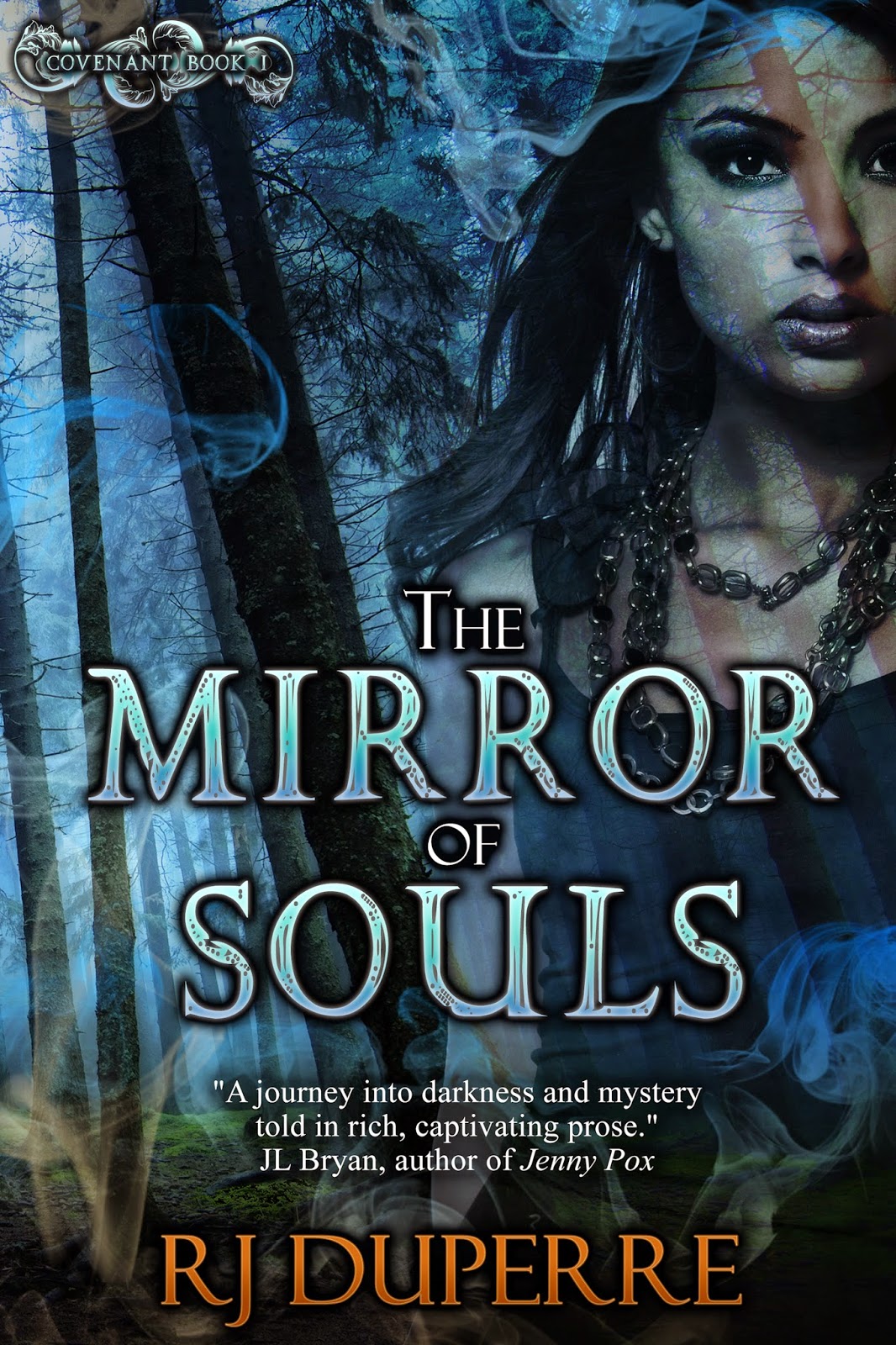
COVER REVEAL: THE MIRROR OF SOULS

Three years ago, I wrote a book called Silas. In that book was a young girl named Jacqueline Talbot, whose character I've been thinking about for a long, long time. I said then that I would one day write her story, and a few months ago, I began to do just that.

That's right, folks. The first book in the Covenant series, The Mirror of Souls, is soon to be published. For the first time ever, here's the cover:

http://www.amazon.com/Mirror-Souls-Covenant-Book-ebook/dp/B00R9PCV7Y

Product description:

Fifteen-year-old Jacqueline Talbot’s boyfriend Mal lives in the mirror of her makeup case. But then there’s never been anything normal about Jacqueline, nor it seems her new hometown of Mercy Hills.

With rumors of actual monsters in the woods, the popular kids taking an unhealthy interest in her, and the revealing of her own dark past, all Jacqueline wants to do is run away forever with Mal. Too bad he’s trapped in the mirror.

But when she learns the ancient forces of the town want to destroy everything she loves, the race is on to free the boy in the mirror, because he just might be the only one who knows how to stop them.


---------------------------------------------------------------------------

The book is currently on pre-order over at Amazon, and I plan on making it available across most platforms come its January 22nd release. This book (and series) is Young Adult with a horror slant. It'll be my first solo new release in over two years, and I'm quite excited about it. (Writing all those books with David Dalglish sure took a lot out of me!) Currently, I'm working on the 2nd book (The Chalice of Desire), with a tentative publication date at the end of April.

In the meantime, there will be another announcement coming in the next few weeks to add even further excitement! I will also be posting the prologue to The Mirror of Souls shortly. So until then, read a good book, dammit! Preferably one of mine!

THE MIRROR OF SOULS PRE-ORDER (CLICK TO PURCHASE)


Wednesday, March 23, 2011

Review: The Ryel Saga by Carolyn Kephart

Rating: 4.9 out of 5


Verbosity.


Most of the time when I pick up a book and see this in action, I roll my eyes and mutter, “Oh, no.” There are just way too many authors that fall in love with their own words, with their ability to craft clever phrasing. They overdo it and overdo it until you just can’t stand to look at the endlessly droning sequences of words any longer. This is usually the result of a writer who’s trying to emulate “traditional” literature without understand what that is in the first place. I’ve struggled through a few of these types of books, and it never ends well.


However, there is a rare breed of verbosity that stems not from self-indulgence, but the uncanny ability to turn a manuscript into magical, epic poetry. In these instances the words are necessary. They build atmosphere, envelop the mind, and spiral the reader into a world they could’ve never imagined.


That, my friends, is Carolyn Kephart’s The Ryel Saga in a nutshell.


I have to admit that at first I was a little wary of this book. It’s long (twice my usual 120k word count limit), it’s wordy, and the plotline spirals in many different directions, seemingly at once. But what I failed to take into account as I first dove in was that this is the work of an author at the top of her game, a writer who fully understands human emotion, doubt, and yearning, a woman who knows how to build a world and recognizes that there are many, many different types of beauty…even in darkness.


The Ryel Saga is named after its main protagonist, Ryel Mirai, a wysard (aka magician, sorcerer, mage) from the mystical city of Markul. He leaves the city in which he’s been raised since his early teen years (when he was lured from his home in the Steppes by his uncle Edris) when he is offered a vision of his dearly loved mother, stricken with sickness and dying. Being well-trained and powerful in the use of the Arts (the Markulian term for magic), and having been trained to be a healer, Ryel brings it upon himself to save her.


Along the way he discovers that he is being sought by a daemon named Dagar, an old sorcerer of dead magic (I guess you could call him a necromancer) whose soul (or rai, as it’s called in the book) lives on even after his body has been destroyed. It seems Dagar wants Ryel’s body, and he’ll stop at nothing – and stoop as low as he can, making Ryel’s life far beyond miserable – to make that happen.


Ryel has other adventures, as well. He uncovers lost family, finds out information about his beloved uncle Edris that rattles his world and turns him into a man possessed, falls in love, thwarts a revolution, starts a revolution, uncovers the mysteries of his Art and its legacy, suffers an ancient malady, and finally fights in a massive battle to save not just the city of Almancar, but the entire realm, as well.


There. I’ve just compressed seven-hundred pages of plot into three short paragraphs. Of course this isn’t everything there is to it – there are intricacies aplenty woven throughout the story – but if I were to make this an actual recap, the review would be fifty pages long.


And besides that – and though this might be funny to say – the strange thing about The Ryel Saga is that the plot, as complex and well thought out as it is, is almost a secondary aspect of the book. Actually, now that I think about it, it might be third in line.


The first thing that grabbed me about the book was the scenery. I mentioned at the beginning how this reminded me of poetry, and the settings are what made me think of this concept. Each city and realm visited is so vividly described that they come to life in the mind’s eye. But, oddly, there is a lot left to the imagination, as well. This might sound like a contradiction, but it’s not. From the sway of the Steppes grasses to the mists surrounding Markul to the gardens and excesses of Almancar to the filthy, deprived buildings in and around the cursed city of Ormala, most everything is explained…so much so that what is left out feels mystical, such as the feel of the street under foot or the gust of the wind on a character’s face. It’s a strange sensation to have while reading…and a wonderful one.


The second, and most fantastic of all, are the emotional ties that bind the characters, both to each other and themselves. There is love aplenty – between siblings, lovers, old rivals, even enemies. There is hatred, shown the most in disease and the scars that result from a life filled with torment. (Two characters, the brothers Essern, beautifully illustrate this point. Look out for their characters. My two favorites in the entire book, after Ryel, himself.) There is the anguish of loss, and the hope that some how, some way, those lost loves might be returned to you. There is longing, for life, love, and family. There is honor amongst heroes, and none among the religious.


And this, as a matter of fact, might be the most profound aspect of the story. In the world of Destimar, religion is as much a bane on the populace as would be cancer on the human body. Religious leaders use their preaching to motivate, organize, and manipulate their charges. And yet the text does not lose sight of the everyday person’s need for belief. I completely loved and appreciated this facet of author Kephart’s storytelling. She comes across as evenhanded, highlighting the wonders and necessity of faith while at the same time illustrating via her fantasy world the way leaders throughout history have used the peoples’ desire for understanding and salvation to turn one sect against the other, triumphing the longing of the many in order to heighten the gains of the few. She doesn’t form an opinion about this and isn’t preachy; she just presents it as simple fact. Though truth be told this reviewer thinks she tips her hand at the end and lets us know, in the tiniest of ways, how she might actually feel about the subject of spiritualism and conviction. I could be wrong, but that’s the way it seemed to me.


Above all else, The Ryel Saga is the story of faith – faith in one’s self, in one’s principles, in one’s ability to overcome. Ryel is the embodiment of this. He believes in his quest. He may doubt himself at times, but he never truly falters. He knows what he’s capable of and trusts in his Art, his magic, and his capacity to learn. In fact, throughout the whole book he never stops learning. He’s like a giant sponge, an advocate for the quest for knowledge, of the viewpoint that to gain knowledge only leads to the desire for more knowledge, and that in the end, we can never stop, but we’d be damned to a life of slow death if we stopped trying.


In case any reading this review need it spelled out for them, despite my initial misgivings, I fell in love with this book. The Ryel Saga is a poignant, touching, somber, and exhilarating read, all in one. The sentiments are real, the small scenes take priority, and the action sequences are tastefully done. In a lot of ways it’s like going on vacation to the island of St. Thomas. You know it’s ornate, you know it’s a commitment, and yet once you get there you can’t help but sit back and enjoy the experience. Reading this book is just like that – like sitting in the sun, letting the emotion of the moment grab you, and allowing it to take you where it may. To run your eyes over each word is a grand event by every definition of the word grand. Let it capture you, let it overwhelm you. Once you reach the end, you’ll understand that you’ve undergone something rare, something beautiful, something you might only see two or three times in your life.


At least this reviewer did. And it’s definitely an experience I’ll never forget.


(Final note to say I docked a single point from the execution grade because of some minor formatting errors, aka a few missing quotes and some character name confusion. These weren’t major issues, however, so the damage is minimal. Definitely does not take away from the enjoyment of the story. Obviously.)


Plot - 10

Characters - 10

Voice - 10

Execution - 9

Personal Enjoyment – 10

Overall – 4.9/50 (4.9/5)


Purchase The Ryel Saga in ebook format for the following devices:


Thursday, November 25, 2010

Review - Erich's Plea by Tracey Alley


Rating: 2.2 out of 5


Reviewing can be a frustrating game.


You dive into a book. You want to love it. You get to know the author, and they’re a super-nice person. And yet sometimes the reading experience lags behind your expectations. You don’t want to be mean, but you owe it to everyone – yourself, your readers, hell even the writer themselves – to be honest.


That’s where I found myself with Erich’s Plea by Tracey Alley.

In its premise, the book is hopeful. Slade, the son of a king, has abdicated his rights to the throne in order to become a druid. He is eventually thrown in prison for nefarious reasons. He dreams of his father, who’s been captured (or killed), and is left instructions on how he should go about plotting his escape. He eventually does, with the help of the typical rogue’s galley of fantasy characters. And in the background of all this, there is the intrigue of a plot to take over the world by a singular dark entity with seemingly unlimited power.


There were a few problems I ran into with the story. First of all, for a main character, Slade is, honestly, not very interesting. He has no charisma, no charm. It’s almost as if he’s simply there. Secondly, the majority of the plot revolves around the big prison escape, which like Slade isn’t very exciting. The reading is quick, but the action scenes are lacking. The head-hopping between characters can be confusing, and the characters themselves are oftentimes clichéd. There reached a point where I wanted to say, “all right, get out of the prison already!” It drags on through the length of the novel, and I begged this particular storyline to end.


This is where I come to the most frustrating aspect of all in this book. Whereas the main story arc, the prison break, is mundane and tiresome, the peripheral occurrences show so much promise, so much thought. The main protagonist in these (too short) sections is Lord Michael Strong. He, along with the grand wizard (or necromancer – I couldn’t figure out which exactly) Lord Nexus are having clandestine meetings to figure out ways in which they can reunite the different kingdoms that always seem to be at odds with each other, under the poisonous eyes of The Dark One, the seemingly all-powerful evil presence.


Through their conversations, Lords Michael and Nexus reveal the history of the world author Alley has built, and it is wonderful. It is a mirror to our own, in which the xenophobia and racism that exists between the warring factions brings down what had the potential to be an almost utopian society. I greatly appreciated these aspects of the book, along with the descriptions of the different types of magic. I found these threads to be original and inventive, and well worth expanding upon.


However, the author doesn’t, and instead we’re thrust back into the boring escape plan.


There’s something else amiss with the work, however, and this has everything to do with The Dark One, himself. He’s painted as an omnipresent figure, one who knows everything that happens around him, who is tyrannical in his rule. And yet we meet him, face-to-face (first mistake), and he’s more like a caricature than a well-fleshed-out villain. Also, for someone so all-powerful, he’s surrounded by spies (second mistake). This lessens his effectiveness and turns the character into a joke. How could such a dominant being with the power of mind-reading and witchcraft at his disposal not know all these characters in his tight inner circle are plotting against him? It simply doesn’t make sense and, although this is strange to say about a work of fantasy, makes the story much less believable.


The writing style the author uses is brisk, but there is something off about it, as well. The comma usage is all over the place. Many of the sentences are run-ons. There is information that is contradictory or unnecessary to the action. Here are a couple prime examples:

As it always did, on those rare occasions that Luca came to this section of the prison, he found the utter silence unnerving, although, at least it masked the screams of the prisoners.


They could all do with some better supplies Slade knew, apart from Lara, Tares and Darzan, who appeared fully equipped, the rest of them carried only arms and equipment purloined from the dead guards.


(Perhaps these represent differences between Australian and American English...I'm not entirely sure)


Not only this, but the author has a tendency to repeat names over and over and over again when a simple “he” or “she” would suffice. This is distracting and more than a little bit maddening, as well.


And yet, all this aside, I would probably read another of Alley’s work if given the opportunity. She does have a playfulness to her tone that I find intriguing. Some of her characters are inventive and break their tropes. She has a good head for societal themes and world-building. It’s simply not present in this book as much as it should be.


I know there are more novels the series. Perhaps she has matured as a writer since this one was written, perhaps not. But if it doesn’t improve, that would be it for me.


As for Erich’s Plea…I found it middling, at best.


Plot - 3

Characters - 5

Voice - 5

Execution - 4

Personal Enjoyment – 5


Overall – 22/50 (2.2/5)


Available at Amazon.com:

Ebook for Kindle

Paperback

Thursday, September 2, 2010

Review: Flaming Dove by Daniel Arenson

Rating: 4 out of 5

This will be my first review that uses my new rating system. I am now judging a book by four criteria – plot, character development, writing style (punctuation, grammar, use of writing devices, etc), and how much the story affected me. These will all be best-of-twenty-five, and when those scores are added together, I come up with the overall rating.

There, that should explain it.

All of which brings me to my latest review – “Flaming Dove” by Daniel Arenson. Now, I read and reviewed Mr. Arenson’s first novel, “Firefly Island”, some time ago. I loved that book. It was everything I was searching for in my fiction. So when his latest book arrived in my Kindle, I thought, “oh yes, here we are, give me more.”

Flaming Dove is the story of Laila, a woman born half-demon, half-angel, during the outset of Armageddon. She is the quintessential loner, existing on the outskirts of what society is remaining after war between heaven and hell broke out on earth, with only her trusted wolf, Volkfair, for companionship. She is surly and a creature without a place to call home, a fact that the novel drives into your head early and often. She fights with modern weapons and kills angels and demons equally, reinforcing the point that she is a woman who belongs to no one. She is, to make a long story short, a wild card in this seemingly endless war.

It seems that heaven and hell have come to a stalemate, you see, and the opposing generals, Beelzebub (who has killed Lucifer to take hold the mantle of hell’s ruler) and the archangel Michael, his brother, are desperate to find an edge, or a loophole, that they can exploit. And both of them look to Laila as being that edge. From the beginning, the battle is on to lure her to one side or the other. Who should Laila choose, being that no matter who wins, she is pretty much screwed? This, to me, was the most interesting part of the novel. This is a creature that has no stake in the outcome, and yet that outcome means everything. It was quite entertaining to watch her flip and flop through her decisions, trying to come up with a satisfying answer to the hardest question of all: where do I belong?

There are huge battles and small, sincere moments that lure the reader in. Most superbly done are Laila’s attack on hell for the former and the struggles of Laila’s sister, the angelic Bat El, as she experiences love for the first time – with a demon, no less – and weighs the consequences of her ultimate decision.

Here it is. Decisions. Much as with Firefly Island, decisions made and not made once again compose the root of Arenson’s novel. Unlike that previous book, however, I found myself not as interested in the outcomes of these decisions. And the reason for this is simple.

Humans.

This is a story of angels and demons pitted against each other. In the whole length of the book, there were two humans introduced, and only one of which who was in any way important to the plot. This confused me. This is Armageddon we’re talking about here, the ultimate face-off to decide the fate of man. And yet, there are no people to be seen. This struck me as an odd way to approach things, for what we get are two opposing sides fighting for what is pretty much a useless, destroyed hunk of rock. Now, I understand that humans have fought for much the same thing over the history of our species, and I assume the point was to paint both sides as being no better than we are – flawed, deceitful, full of pride, and easily wounded. This is all well and good, and I applaud the effort, but the problem a tale such as this has is that you’re fighting the religious stereotypes that have been passed down for thousands of years. Angels reflect the good, demons the bad. Sure, there are biblical stories of angels being less than completely pious, but still there is the assumption that, come the end of the day, they are righteous. To paint them as otherwise is a slippery slope and difficult to pull off.

In certain ways, the author does succeed. I found myself caring about all the peripheral characters, Beelzebub and Bat El more than all. And this took skill. However, with both sides being flawed and hard to root for, not to mention almost indistinguishable from each other, the novel must rely on Laila to carry the word of the day.

For the most part, she is up to the challenge. She is presented, as I said earlier, as a jaded loner. Actually, in almost every way she is the picture of humanity, which makes the decision to cut out the human element of the plot all the more bothersome. Because at the end of the day, though she is much like us, she is still a powerful (and immortal) being with claws, wings, and a halo of fire. This makes her, even in her state of emotional unrest, somewhat difficult to relate to, which also makes the themes the author is trying to get across fall a bit flat.

As for those themes, I get it. There is no such thing as pure good and evil. However, I simply don’t feel like it was unveiled well enough to strike a poignant chord in me. Also, these themes, as well as other things, are repeated, time after time, which can get a bit tiresome. I understand that Laila has no home, that she feels as if she doesn’t belong anywhere. I understand that blades glint, scales shimmer, and both angels and demons have wings. To bring these points up time and again makes the writing stagnate, which doesn’t aid when trying to keep a reader entrenched in the writer’s world.

Now, I understand that this review sounds like I’m blasting the novel. I’m not trying to. I did enjoy it, only not as much as I thought I should have. You see, Arenson is a supremely talented writer. Even with what I see to be bad decisions in regards to the plot and execution of the story, it is imminently readable. The battle scenes are epic, the dialogue flows smoothly. The characters were fleshed out and believable. The emotional chords between a girl who’s never loved and a man who’s loved too much are heartbreaking. The ending shocked me with its power. (Though this book will forever end at chapter 21 for me, because the last chapter seemed like piling on, preaching, and trying to set up a possible sequel) But I wanted more. Especially after reading Firefly Island, I expected it.

At the end of the day, even with all my ranting, Flaming Dove is a good book. It will keep you turning the page and make you care for the people who inhabit it. My problem is that it’s not great.

But then again, that could be only me. You might think differently. So check it out, because even with its faults it is worth the price of admission.

Plot – 9

Characters – 7

Voice – 9

Execution - 9

Personal Enjoyment – 6

Overall - 40/50 (4.0/5)


Buy Flaming Dove for the Amazon Kindle

Sunday, November 15, 2009

Review: FEAST by R. Scott McCoy


If the contents of my last article weren’t enough to tell you, let me speak plainly that I am an individual who is constantly looking to expand my horizons when it comes to the materials I read. There are times that I tire of reading the same “Big Four” of the horror industry, though this is not to say that I bore of their work. Quite the contrary, actually; what I really desire is to find different points of view, to explore differing ways of building plot and character. As I’ve said many times before, this is how we grow as writers; without a diversity of the ideas we intake, creativity and innovation suffer. If you want a perfect example of this, just take a quick peek at our nation’s capital.

Needless to say, I was quite excited when FEAST, a slim little slice of morbidity from R. Scott McCoy, arrived at my doorstep. Mr. McCoy is, along with his career as a writer, the publisher and editor of NECROTIC TISSUE MAGAZINE, a former e-zine which will soon be publishing its first print issue. This is a man who sees literally thousands of manuscripts come across his desk monthly. One would think he possesses a pretty decent grasp of what people in general like to read.

With Feast, Mr. McCoy proves the truth in this assumption.

Feast is the story of Nick Ambrose, deputy sheriff of Santa Cruz, California. He is a man of duty and honor, who also has the innate ability to read a person’s guilt. His brother, Pete, is also a police officer, and at the beginning of the story we find the two of them together, driving through rural California to investigate the dwelling of a man named Donald P. Reid, who is suspect of being involved in a series of kidnappings.

This is the start of the tale, and it takes no time at all before the action starts. Events turn interesting very quickly. By the time the third chapter rolls around, Nick is left to deal with newfound abilities (and their consequences) that he would have never imagined, even in his wildest dreams. He proceeds to stumble into San Francisco, presumed dead by his peers, armed with power he doesn’t understand and a head that now has not one resident but three, in search of a childhood friend, who to him is the only one who can help him.

I will not go into detail about the rest of the book, because that will only lessen your enjoyment of the read. There are twists and turns and conflict with the purest of evils, which is man’s inherent greed. Nick of course triumphs, but there is no doubt that, by the time the end of the book rolls around, that he will face obstacles on his road ahead, and most of them will prove to be horrible, indeed.

Feast incorporates themes and contrivances that are common in both horror and fantasy, such as the swallowing of souls and the ability to read the auras of individuals as if were were visible lifelines. Though the tools are common, I found the execution to be original and inspiring. Instead of the plot driving the characters, in this tale we have Nick, the protagonist, moving the story along. He acts with confidence (even through his inner uncertainty) and uses his own personal torment to come to grips with the way his situation, and his future, have changed. This is a nice change of pace from the usual, where the outside elements – the ghosts and ghouls who populate the story – dictate where the path leads.

This is not a deep book; the characters, while flawed, are inherently simple. There is nary a philosophical waxing to be seen. And this is not an insult. The book is what it is; a story of character development and action, where each page brings a new trial and a new set of obstacles to overcome. This makes the story read quite quickly, and there is a lot of charm in its straightforwardness. Can you tell I enjoyed it?The only complaint that I have about FEAST is its length. At 155 pages, it reads as the first few chapters of a much larger work. The end leaves you thirsting for more, bad pun intended. I wished there were more story there, as by the time I finished I felt the story had really picked up steam and then left me hanging. I realize that this is a function of small press, where the shorter (and cheaper to produce) is the better, but it still was a bit frustrating. Here’s hoping, from this reader’s perspective, that there are more tales of Nick Ambrose on the way.

To purchase your own copy of Feast, please visit Amazon.com.

Thank you once again for your time. This little book is a gem. You will not be disappointed.